
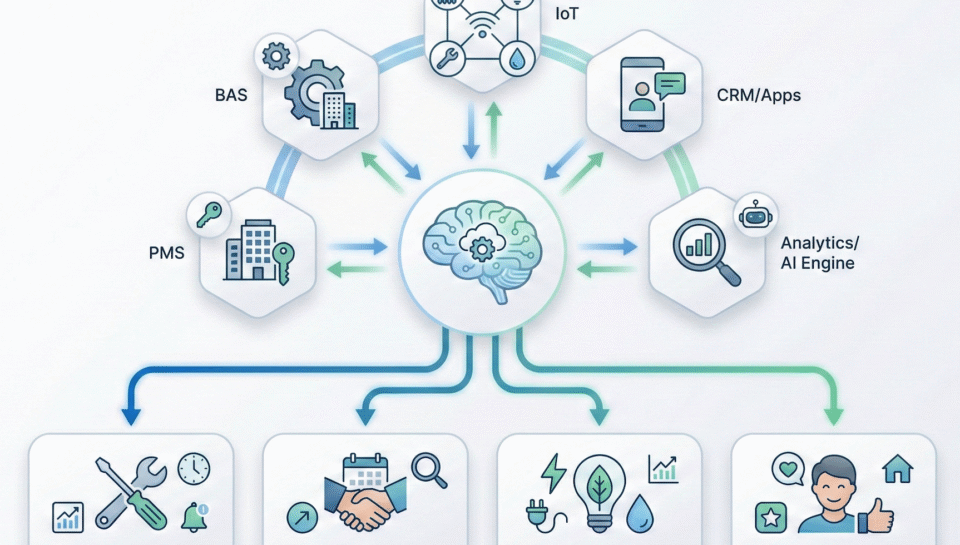
Multifamily isn’t just about units and leases anymore—it’s a living data ecosystem. Today, the operators winning big aren’t simply those with the most assets. They’re the ones who integrate their tech stack, unify data streams, and operationalize AI across platforms to cut costs, protect NOI, and deliver an exceptional tenant experience.
If your PMS, BAS, analytics tools, resident apps, and reporting systems aren’t communicating, you’re leaving efficiency, revenue, and competitive advantage on the table.
This playbook, developed in part by Tyson Dirksen and the Evolve Development Group team, lays out how AI integration works in practice across multifamily portfolios—what drives results, what fails in the field, and how to design a rollout that delivers measurable outcomes from day one.
Why Integration Matters Today
By 2025, AI will have moved from optional to mission-critical for multifamily operators. Leading firms now expect:
-Automated operational workflows
-Unified data across leasing, operations, and maintenance
-Real-time analytics that inform actionable decisions
AI that isn’t integrated is a siloed tool, not a force multiplier. Research shows that combining cloud infrastructure, big data, and AI dramatically improves real-time operational insights and decision-making across portfolios (Adoption of AI in Property Management, 2025).
Common Integration Challenges—and How to Solve Them
1. Disconnected Operational Systems
Most portfolios operate on a patchwork: Yardi or RealPage for PMS, standalone IoT and BAS for HVAC and energy, separate CRM platforms, and spreadsheets filling the gaps. The result? Blind spots instead of clarity.
Solution:
Implement a central data orchestration layer—a portfolio-wide “backbone” that ingests all data in real time and normalizes it into a single operational view. This enables analytics, automation, and AI-driven insights (SurfaceAI, 2025).
2. Poor Data Quality and Governance
AI is only as reliable as the data it consumes. Messy, inconsistent, or incomplete datasets undermine predictive maintenance, leasing intelligence, and tenant analytics.
Solution:
Develop rigorous data governance practices: define rules for collection, validation, and updates. Modern AI governance tools can automate compliance checks, track lineage, and flag anomalies to prevent dirty data from contaminating your insights (Tewari, 2025).
3. Legacy Workflows That Block Adoption
Technology doesn’t exist in isolation. Without redesigned workflows, AI becomes an expensive decoration instead of operational leverage.
Solution:
Redesign critical workflows with automation in mind: remove redundant manual steps, define triggers (like auto-assigning work orders from sensor alerts), and ensure clear handoffs between staff and AI systems (Keshman, 2025).
Four Core Pillars of AI Integration
Pillar 1: Unified Data Architecture
AI thrives on centralized, clean, accessible data.
Action Steps:
-Audit all PMS, BAS, CRM, IoT, and financial systems
-Define a shared data model across assets
-Automate data ingestion, normalization, and validation
Fragmented data cripples analytics. Unified datasets make AI actionable (ResearchGate, 2025).
Pillar 2: API-First Technology Stack
Systems must talk. Platforms with robust APIs (Yardi, Entrata, RealPage, MRI, SmartRent, Latch) enable workflow automation rather than manual handoffs.
Best Practices:
-Ensure API access across all critical systems
-Standardize authentication and security
-Monitor and log all integration endpoints
API-first design is now a defining feature of scalable property technology in 2025 (Inoxoft, 2025).
Pillar 3: Real-Time Analytics & Orchestration
AI doesn’t live in dashboards—it lives in decision loops.
Example:
-BAS feeds HVAC performance
-PMS feeds occupancy and work order history
-CRM feeds tenant feedback
-Analytics engine correlates patterns and triggers AI workflows
This is where dashboards become operational automation, optimizing portfolios across assets (SurfaceAI, 2025).
Pillar 4: Governance, Compliance & Security
As data flows faster, governance must accelerate.
Requirements:
-Role-based access and auditing
-Versioned data pipelines
-Compliance with tenant privacy laws
AI-driven governance tools automate monitoring and anomaly detection, keeping pace with high-volume operations (Tewari, 2025).
Concrete Examples of Integration Platforms
1️⃣ Enterprise-Grade Platforms (Portfolio-Wide Backbones)
-Microsoft Azure Data Stack: Ingests Yardi/RealPage/MRI, BAS like Niagara/Honeywell/Siemens, and IoT sensors; Azure Synapse/Databricks normalizes data; Power BI + AI models drive automation. Used by REITs and institutional owners; scales across thousands of units.
-AWS Real Estate Data Lake: AWS Glue + Lambda ingest PMS, BAS, leasing data; SageMaker runs AI models; QuickSight for dashboards. Ideal for tech-forward operators; enables real-time event-driven automation.
2️⃣ Real Estate–Specific Middleware
-MuleSoft (Salesforce): Middleware connecting PMS, CRM, and tenant experience platforms; normalizes data for operational visibility.
-Workato: Connects PMS, BAS, accounting, and analytics; automates workflows and triggers (e.g., HVAC alerts → work orders → maintenance → analytics logs).
-Boomi (Dell Boomi): iPaaS platform for real-time data normalization; handles legacy PMS systems; widely used in CRE.
3️⃣ AI-Native Orchestration Layers
-Surface (Dude Solutions alumni): Centralizes PMS, maintenance, IoT; applies AI for predictive insights.
-VTS Data / VTS Activate: Centralizes leasing and asset performance; increasingly overlays AI for portfolio intelligence.
4️⃣ Building Automation–First Data Backbones
-Niagara Framework (Tridium): Vendor-agnostic integration across HVAC, lighting, energy, and security; common in Class A assets.
-BrainBox AI + Data Lake: Real-time HVAC optimization; data feeds into PMS for work orders and reporting; directly tied to NOI outcomes.
5️⃣ Lean Mid-Market Stack
-PMS: Yardi / AppFolio
-BAS: Smart thermostats + IoT
-Integration: Workato or Zapier
-Data Store: Snowflake / BigQuery
-Analytics: Power BI / Looker
-AI: Custom ML models or vendor overlays
Cost-effective, fast to deploy, and still delivers meaningful automation.
Step-By-Step Integration Roadmap
-
Integration Audit: Map all systems, data sources, and workflows
-
Data Governance Blueprint: Define ownership, validation rules, retention, and security
-
Choose an Integration Layer: Middleware supporting API ingestion, normalization, and triggers
-
Consolidate Data Streams: BAS, PMS, CRM, IoT, and analytics
-
AI Activation & Monitoring: Deploy AI incrementally—start with one use case
-
Workflow Redesign: Embed AI outputs into operational playbooks
-
Measure & Iterate: Track cost per unit, response times, and NOI impact
What a Single View Unlocks
-Unit-level maintenance risk
-Energy spend vs. occupancy
-Tenant satisfaction vs. response time
-NOI leakage by asset
-Predictive CapEx timelines
AI becomes operational leverage, not just a tool.
0.01% Operator Truth
AI alone doesn’t create alpha—integrated systems do.
If your PMS, BAS, and analytics aren’t connected:
-AI predictions are blind
-Automation fails
-Staff ignores insights
-ROI collapses
When done correctly, integration compounds operational gains and positions your portfolio for market dominance.



1 Comments
Multifamily AI Integration - Evolve-us
December 14, 2025 - 1:31 pm[…] Read original blog at https://tysondirksen.com/ai-integration-multifamily/ […]