America’s housing crisis is one of the most urgent challenges in the United States. The country is short 4.5–5 million homes, a deficit that drives rents sky-high, displaces families from high-opportunity neighborhoods, and limits economic mobility (Brookings, 2024; U.S. Chamber of Commerce, 2025).
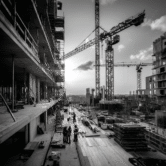
Those building our cities are working tirelessly. Developers, contractors, and tradespeople pour concrete, erect steel, and cut timber—but despite their efforts, millions of families remain unable to afford a home.
The underlying issue is not demand, interest rates, or zoning alone. The deeper cause is construction productivity, which has declined more than 30% since 1970, while the broader economy doubled output (Yeh, 2025). While other industries figured out how to produce more efficiently, construction has largely stalled.
This decline explains why projects drag on, costs escalate, and supply lags far behind demand. It also fuels the affordability crisis. According to the National Association of Realtors (2024), only about 36% of homes sold nationwide are affordable to a median-income family. Even when new units are built, many remain out of reach.
The Scale and Stakes of the Shortage
The shortage is not just a number—it shapes the everyday lives of millions. Household formation continues to grow, population is rising, yet housing construction has lagged every year since the Great Recession. Cities report long waiting lists, rising rents, and increased crowding in urban cores.
For further context on productivity trends and how they amplify the shortage:
👉 How Construction Labor Productivity Dropped 30%
Why Productivity Matters
Construction is the only major U.S. industry where productivity has fallen over the last 50 years (Yeh, 2025; Richmond Fed). Labor-intensive processes, fragmented contracting, and slow adoption of industrialized methods make projects slower, costlier, and less predictable.
Lower productivity drives higher costs, which worsens affordability. Fewer homes are built, and the ones that are built often remain inaccessible to median-income families.
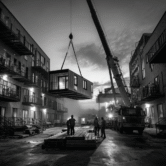
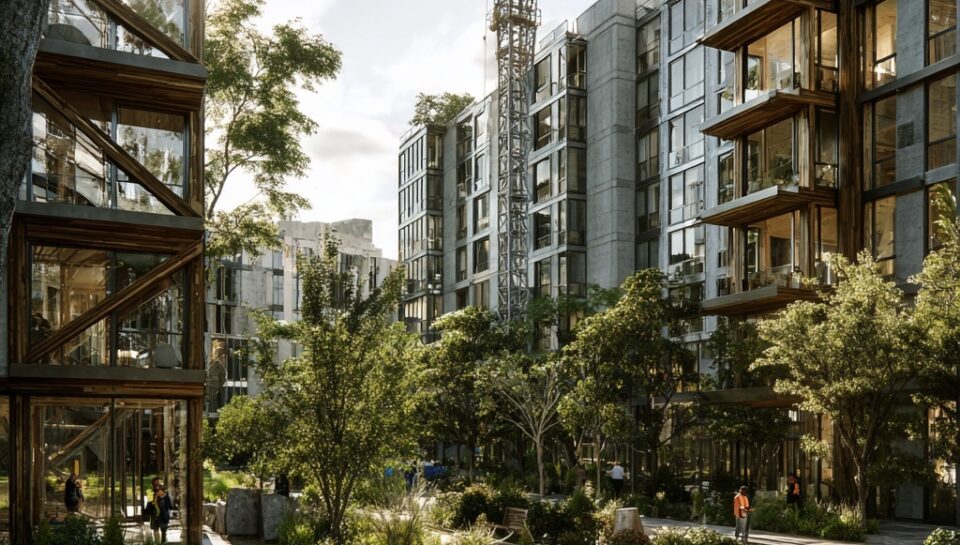
The solution lies in industrialized construction: prefabricated modular units, panelized systems, and mass timber mid-rise buildings can cut construction timelines 20–50%, reduce waste, and improve quality (McKinsey, 2019; 2025). Mass timber allows for low-carbon, repeatable structures, enabling faster production without sacrificing design or livability.
Affordability and Policy Solutions
Efficiency alone cannot ensure affordability. Policy levers are critical. Current tax credits, low-interest construction loans, and zoning incentives often fall short of fully offsetting the cost gap between market-rate and affordable units.
Key approaches include:
- Equate the cost of tax-incentivized affordable units with traditional market-rate units, removing the financial disincentive to build affordability.
- Streamlined permitting and pre-approved designs for affordable housing to reduce delays and risk.
- Density bonuses and land-use flexibility to make mid-rise, affordable developments financially feasible.
These measures make affordable housing economically comparable to market-rate units while ensuring median-income families can access homes.
Collaboration and Scaling Solutions
No single technology or policy can solve the housing shortage alone. Cities must reduce regulatory bottlenecks. Federal and state governments need to expand and simplify tax incentives. Developers, investors, and communities must coordinate so that industrialized construction can scale efficiently.
The United States has solved massive industrial challenges before—autos, steel, and consumer electronics. Housing can follow the same path—but it will require bold action, coordination, and modernization of production and policy.
The Path Forward
Industrialized construction, smarter tax incentives, streamlined permitting, and workforce modernization are the keys to closing the 5 million unit gap. Combining these levers makes affordable, mid-market housing feasible at scale.
This is a structural, solvable problem. The tools exist. The challenge is executing at scale—and ensuring housing becomes accessible for the median-income family.