
Construction Productivity: Unlocking the Physical Ability to Build at Scale
Introduction: The Physical Constraint on Development
Real estate development ultimately depends on the ability to build.
Capital may be available.
Zoning may permit development.
Demand for housing may be strong.
But if the construction industry cannot physically produce buildings efficiently, development will slow.
Construction productivity therefore represents the physical constraint within the real estate development system.
For decades, economists and industry researchers have observed that construction productivity has grown far more slowly than productivity in other sectors of the economy.
In the United States, construction labor productivity declined by more than 30 percent between 1970 and 2020, even as productivity in the broader economy more than doubled. (Federal Reserve Bank of Richmond)
This divergence has profound implications for housing supply, development economics, and urban growth.
If the industry responsible for producing buildings becomes less productive over time, the cost of construction rises and the pace of development slows.
Understanding construction productivity is therefore essential for understanding both real estate development and housing supply.
Key Ideas
- Construction productivity determines how efficiently buildings can be produced.
- Productivity in construction has stagnated for decades relative to other industries.
- Fragmented project delivery systems, regulatory complexity, and limited technological adoption contribute to slow productivity growth.
- Declining construction productivity directly affects housing supply and development costs.
- Improving productivity is essential for expanding housing production at scale.
The Construction Productivity Gap
Across the global economy, most industries have experienced steady productivity improvements.
Manufacturing, logistics, and technology sectors have benefited from automation, standardization, and process optimization.
Construction has largely failed to experience similar gains.
Between 2000 and 2022, global construction productivity improved by only about 10 percent, compared with roughly 50 percent growth in the broader economy. (McKinsey & Company)
In many advanced economies, construction productivity has been stagnant or declining for decades.
Researchers have noted that the productivity gap between construction and other sectors has widened steadily since the 1970s. (Construction Physics)
This productivity divergence has major consequences for development.
When productivity stagnates:
- projects require more labor per unit of output
- construction timelines lengthen
- building costs increase
These effects ripple throughout the development system.
Why Construction Productivity Has Stagnated
Several structural factors contribute to slow productivity growth in construction.
These include:
Fragmented Industry Structure
Construction is composed largely of small firms operating on individual projects.
Unlike manufacturing, where production occurs in centralized facilities, construction is typically organized around one-off projects.
This fragmentation limits the industry’s ability to standardize processes and invest in productivity-enhancing technologies.
Project-Based Production
Each building is effectively a prototype.
Design variations, site conditions, and regulatory requirements often require customized construction processes.
This reduces opportunities for standardization and economies of scale.
Regulatory and Land Use Constraints
Regulatory processes and land use rules can also influence construction productivity.
Research suggests that stricter land use regulation is associated with smaller construction firms and lower productivity levels. (NBER)
These regulatory systems are explored further in Zoning and Land Use: The Systemic Gatekeeper of Scalable Housing: https://tysondirksen.com/zoning-land-use-the-systemic-gatekeeper-of-scalable-housing/
Construction Productivity and Housing Supply
Construction productivity directly influences housing supply.
If builders require more labor hours to produce each unit of housing, fewer homes can be built within a given timeframe.
This constraint contributes to housing shortages in many markets.
These housing system dynamics are explored in Housing Shortage as a Systems Failure: https://tysondirksen.com/housing-shortage-systems-failure-developer-perspective/
When construction productivity stagnates, development costs rise and the pace of housing production slows.
Even when zoning allows development and capital is available, limited construction capacity can prevent housing supply from expanding.
Construction Within the Development System
Construction does not operate independently.
It functions within the broader real estate development system, which includes:
- capital allocation
- entitlement processes
- development governance
- project delivery mechanisms
These systems determine how development projects move from concept to completion.
This broader framework is explored in Commercial Real Estate Development Systems: https://tysondirksen.com/commercial-real-estate-development-long-term-performance/
Capital allocation also influences construction activity, since development projects depend on financing structures that determine project feasibility. These financial frameworks are discussed in Capital Discipline in Real Estate Development:
https://tysondirksen.com/capital-allocation-discipline-real-estate/
Technology and the Future of Construction Productivity
Improving construction productivity will likely require technological and organizational innovation.
Potential sources of productivity improvement include:
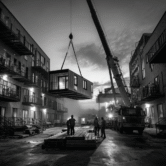
- prefabrication and modular construction
- robotics and automation
- building information modeling (BIM)
- digital project management systems
Advances in robotics and digital modeling may help construction firms coordinate complex projects more efficiently and reduce labor requirements. (arXiv)
However, technology alone is unlikely to solve the productivity challenge.
Improving construction productivity will also require changes in:
- project delivery systems
- development coordination
- regulatory processes
These delivery systems are explored in Delivery Mechanisms: Translating Policy into Production: https://tysondirksen.com/delivery-mechanisms-translating-policy-into-production/
Construction Productivity and Development Economics
Construction productivity influences nearly every aspect of development economics.
When productivity declines:
- construction costs increase
- development margins compress
- housing supply slows
These effects can influence capital allocation decisions within development firms.
Developers and investors must therefore evaluate productivity risks when underwriting projects.
These capital allocation frameworks are explored in Stress-Tested Investing for Institutional Capital: https://tysondirksen.com/stress-tested-investing-for-institutional-capital/
Conclusion: Productivity Determines How Much We Can Build
Real estate development depends not only on policy and capital.
It also depends on the physical capacity of the construction industry.
Construction productivity determines how efficiently buildings can be produced.
When productivity stagnates, development becomes slower and more expensive.
This productivity challenge has become one of the most important constraints on housing supply and real estate development.
Understanding the role of construction productivity within the broader development system is therefore essential for addressing housing shortages and enabling large-scale development.
Frequently Asked Questions
What is construction productivity?
Construction productivity measures how efficiently labor, materials, and equipment are used to produce buildings or infrastructure.
Why has construction productivity stagnated?
Several factors contribute to slow productivity growth in construction, including fragmented industry structure, project-based production, regulatory complexity, and limited technological adoption.
How does construction productivity affect housing supply?
Lower productivity means that more labor and time are required to build each housing unit, which slows housing production and increases development costs.
Can technology improve construction productivity?
Yes. Technologies such as modular construction, robotics, and building information modeling may improve efficiency, but organizational and regulatory changes are also necessary.
Related Framework Articles
Housing Systems
Housing Shortage as a Systems Failure
https://tysondirksen.com/housing-shortage-systems-failure-developer-perspective/
Zoning and Land Use: The Systemic Gatekeeper of Scalable Housing
https://tysondirksen.com/zoning-land-use-the-systemic-gatekeeper-of-scalable-housing/
Misaligned Capital Flows: The Financial Bottleneck to Housing Production
https://tysondirksen.com/misaligned-capital-flows-the-financial-bottleneck-to-housing-production/
Delivery Mechanisms: Translating Policy into Production
https://tysondirksen.com/delivery-mechanisms-translating-policy-into-production/
Development Systems
Commercial Real Estate Development Systems
https://tysondirksen.com/commercial-real-estate-development-long-term-performance/
Capital Allocation
Capital Discipline in Real Estate Development
https://tysondirksen.com/capital-allocation-discipline-real-estate/
Stress-Tested Investing for Institutional Capital
https://tysondirksen.com/stress-tested-investing-for-institutional-capital/
Long Cycle Development Risk Management
https://tysondirksen.com/long-cycle-development-risk-management/