Housing Supply and Construction Productivity
The Structural Constraint on Housing Production
Introduction
Housing shortages are often explained through a single variable.
Some observers emphasize restrictive zoning. Others focus on development capital, interest rates, or regulatory approvals. Rising construction costs are also frequently cited as the primary constraint on housing production.
Each of these explanations captures part of the picture. But housing supply ultimately depends on something more fundamental: the physical ability to build.
Even when zoning permits development and capital is available, housing production cannot expand if the construction industry cannot efficiently deliver buildings.
Housing supply is therefore not only a policy problem or a capital markets problem. It is also a production problem.
Understanding housing shortages requires examining the systems that convert land, capital, regulatory approvals, and construction capacity into finished housing.
From a development systems perspective, housing production emerges from the interaction of several structural forces. Construction productivity sits at the center of this interaction because it determines how efficiently the industry can translate development approvals and capital investment into completed buildings.
Key Ideas
- Housing supply emerges from multiple interacting systems, including land-use regulation, capital allocation, governance frameworks, and construction delivery.
- Construction productivity has stagnated for decades relative to the broader economy.
- Even when zoning and capital support development, housing production cannot scale if construction systems cannot deliver buildings efficiently.
- Industrialized construction methods may improve productivity, but adoption remains limited across the industry.
- Durable capital structures are required for development projects that unfold across multi-year timelines involving entitlement approvals and construction delivery.
Systems Explanation
Housing Supply as a Production System
Housing production is often discussed primarily as a policy challenge. In practice, it functions as a production system.
Delivering housing requires coordination across several structural systems:
- land-use regulation and entitlement approvals
- development capital and financing structures
- governance relationships between developers and investors
- construction delivery systems and building technologies
If any one of these systems becomes constrained, housing production slows. When multiple systems become constrained simultaneously, housing shortages can persist for extended periods.
This broader perspective is explored in Housing Shortage as a Systems Failure: https://tysondirksen.com/housing-shortage-systems-failure-developer-perspective/
Development outcomes rarely depend on a single policy decision or market signal. Instead, they emerge from the interaction of regulatory systems, capital markets, and construction delivery across long development timelines.
The Construction Productivity Divergence
Across most sectors of the economy, productivity has increased dramatically over the past half-century.
Manufacturing output per worker has risen significantly. Logistics networks have become increasingly efficient. Information technology has transformed the productivity of knowledge work.
Construction has followed a different trajectory.
Research from the Federal Reserve Bank of Richmond indicates that U.S. construction labor productivity has declined substantially since 1970, while productivity across the broader economy has more than doubled.
This divergence has significant implications for housing supply.
If the industry responsible for producing buildings becomes less productive over time, the cost of construction rises while the pace of housing delivery slows.
These dynamics are explored further in Why Construction Labor Productivity Has Declined Since 1970: https://tysondirksen.com/how-is-it-possible-that-construction-labor-productivity-has-dropped-more-than-30-since-1970-while-the-rest-of-the-economy-doubled/
Structural Barriers to Construction Productivity
Several characteristics of the construction industry make productivity improvements difficult.
Unlike manufacturing, construction projects are rarely standardized. Each development typically involves:
- a unique site condition
- a distinct design and engineering team
- a different contractor group
- a specific regulatory environment
- a unique financing structure
Buildings are therefore produced primarily as one-off projects rather than repeatable products.
Regulatory complexity also slows productivity improvements. Permitting systems, inspection procedures, and building codes vary significantly across jurisdictions, limiting the ability to standardize construction processes.
Because of these structural conditions, construction productivity has historically improved far more slowly than productivity in manufacturing or technology sectors.
Construction Productivity as a Constraint on Housing Supply
When housing demand increases, supply cannot immediately respond.
Development projects must first move through several stages:
concept → entitlement → financing → construction → occupancy
Even after zoning approvals and financing are secured, housing production ultimately depends on construction delivery.
If construction capacity is constrained or inefficient, housing supply cannot expand quickly enough to meet demand.
This dynamic helps explain a pattern observed across many urban markets:
Demand increases faster than housing production. Prices rise. Development pipelines struggle to keep pace.
Even when zoning reforms expand development capacity, housing production may remain constrained if construction productivity remains low.
The role of construction systems in development outcomes is explored in Construction Productivity: Unlocking the Physical Ability to Build at Scale: https://tysondirksen.com/construction-productivity-unlocking-the-physical-ability-to-build-at-scale/
Industrialized Construction Approaches
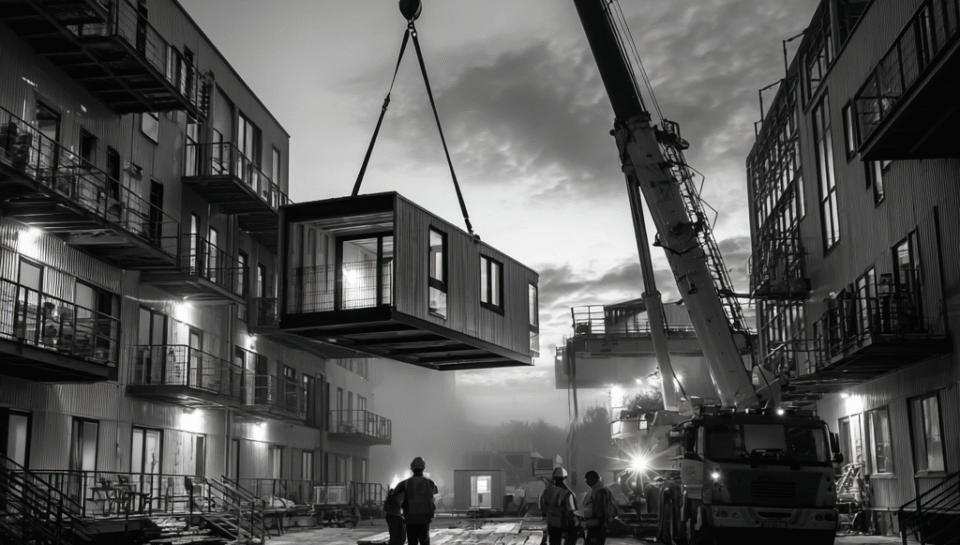
Some observers argue that industrialized construction methods could help address these productivity challenges.
Examples include:
- modular construction
- prefabricated building systems
- panelized construction
- mass timber structural systems
These approaches attempt to shift portions of building production toward manufacturing-style processes through greater standardization and off-site fabrication.
However, adoption remains limited.
Improving construction productivity typically requires not only technological innovation but also changes in procurement systems, contractor coordination, project sequencing, and regulatory frameworks.
Capital Discipline and Development Durability
Capital structure also plays an important role in housing production.
Development projects often require capital that remains committed across multi-year timelines involving entitlement approvals, design coordination, and construction delivery.
Projects financed with fragile capital structures can become vulnerable when timelines extend or construction costs increase.
Durable capital structures increase the probability that projects will ultimately reach completion.
This relationship between capital discipline and development outcomes is explored in Capital Allocation Discipline in Real Estate:
https://tysondirksen.com/capital-allocation-discipline-real-estate/
Long-duration capital structures are often necessary in development environments where regulatory timelines and construction delivery introduce significant uncertainty.
Advisory and Development Execution
Complex development environments often require both strategic advisory and disciplined execution systems.
Early-stage development strategy, feasibility calibration, and structural risk analysis may occur through Durata Advisory: https://durataadvisory.com
Principal development initiatives and project execution platforms may operate through Evolve Development Group: https://evolve-us.com
These complementary structures address different stages of the development lifecycle—from early strategic analysis through project execution.
FAQ
Why is construction productivity important for housing supply?
Construction productivity determines how efficiently buildings can be produced. If productivity declines or stagnates, the cost of construction increases, and the pace of housing delivery slows.
Can zoning reform alone solve housing shortages?
Zoning reform can expand development capacity, but it does not guarantee housing production. Housing supply also depends on development capital, project governance, and construction delivery systems.
Why has construction productivity improved more slowly than other industries?
Construction projects are typically produced as unique, one-off developments rather than standardized products. Regulatory complexity, fragmented project teams, and site-specific conditions also make productivity improvements more difficult.
Could industrialized construction improve housing supply?
Industrialized construction approaches, such as modular or prefabricated systems, may improve productivity. However, widespread adoption requires changes in procurement systems, regulatory frameworks, and project delivery models.
Why does capital discipline matter for housing production?
Housing development projects unfold across multi-year timelines. Durable capital structures allow projects to withstand regulatory delays, cost volatility, and construction risk, increasing the likelihood that projects reach completion.
Related Framework Articles
Housing Shortage as a Systems Failure
https://tysondirksen.com/housing-shortage-systems-failure-developer-perspective/
Construction Productivity: Unlocking the Physical Ability to Build at Scale
https://tysondirksen.com/construction-productivity-unlocking-the-physical-ability-to-build-at-scale/
Why Construction Labor Productivity Has Declined Since 1970
https://tysondirksen.com/how-is-it-possible-that-construction-labor-productivity-has-dropped-more-than-30-since-1970-while-the-rest-of-the-economy-doubled/
Capital Allocation Discipline in Real Estate
https://tysondirksen.com/capital-allocation-discipline-real-estate/
Commercial Real Estate Development and Long-Term Performance
https://tysondirksen.com/commercial-real-estate-development-long-term-performance/
Signature Line
Tyson Dirksen writes about real estate development systems, capital discipline, housing production, and construction delivery across complex development environments.