
When I sat down to write a blog about America’s housing shortage—a topic that deserves urgent national attention—I stumbled onto a statistic that stopped me in my tracks. While researching production gaps, regulatory drag, and supply constraints, I came across a claim from the Federal Reserve Bank of Richmond that seemed almost impossible: construction labor productivity has actually decreased by more than 30% since 1970, while the rest of the U.S. economy has doubled (Richmond Fed, 2025).
As the founder of Evolve Development Group, this immediately resonated with me. Across many of our past projects—which have tended to be highly custom and luxurious—we’ve felt the drag of labor inefficiencies, extended schedules, and complexity. These challenges aren’t just abstract statistics; they are something we experience firsthand. And honestly, it bugged me. How could this be true when innovation has transformed nearly every other sector?
Before completing the housing-shortage blog (coming shortly), I decided to dig into this productivity paradox. What I found was both fascinating and instructive. It also explains why Evolve is pivoting toward more affordable and production-oriented housing using mass timber, prefabricated panelization, and repeatable design systems, which promise to increase efficiency, scale, and predictability in our projects.
The Data Behind the Decline
The headline insight comes from the Federal Reserve Bank of Richmond’s Economic Brief, “Five Decades of Decline: U.S. Construction Sector Productivity” (Richmond Fed, 2025):
“Construction labor productivity fell by more than 30 percent from 1970 to 2020, while overall U.S. economic productivity doubled.”
This is measured as real output per worker, the standard benchmark for productivity across sectors.
Other research reinforces the trend:
- The U.S. economy as a whole has more than tripled labor productivity since 1948 (BLS, 2024).
- Construction is a “major outlier” among all industries (NBER, 2025).
- Even when using “physical” measurements—like housing units per worker—construction productivity is stagnant or declining (Hsieh & Klenow, 2024; BFI Chicago, 2025).
In short: no matter how you measure it, construction has fallen behind.
Why Has Construction Productivity Declined?
It may seem counterintuitive—every other major industry has embraced innovation, scaling, and automation. Construction, by contrast, faces a unique set of challenges:
1. Measurement Challenges Exist, But Don’t Tell the Whole Story
The Richmond Fed (2025) notes several potential measurement issues:
- Difficulty valuing construction output due to custom designs
- Challenges tracking subcontractors and undocumented labor
- Possible underestimation of quality improvements
- Problems with deflators for construction costs
Even after accounting for these, studies using “physical output” measures, like square footage per worker, still show clear declines (BFI Chicago, 2025).
2. Regulation and Land-Use Constraints
One of the most significant contributors is regulatory:
- Strict zoning and permitting processes restrict project scale
- Smaller project sizes reduce the ability of firms to achieve economies of scale
- Long entitlements and compliance requirements add labor hours and slow schedules
The Richmond Fed (2025) explains that restrictive land-use rules disincentivize construction companies from investing in technology or scaling operations, limiting productivity growth. NBER research (2025) confirms that stricter land-use regulation correlates with smaller, less productive construction firms.
3. The Site-Specific, Resistant-to-Automation Nature of Construction
Unlike manufacturing, construction is:
- Performed outdoors
- Dependent on weather
- Unique for each site
- Subject to local politics and inspections
These realities limit:
- Standardization
- Automation opportunities
- Capital investments in labor-saving technology
The University of Chicago’s “Strange and Awful Path of Construction Productivity” (BFI Chicago, 2025) highlights how capital deepening has lagged in construction compared to other sectors.
4. Workforce Fragmentation and Skill Gaps
The construction workforce has become increasingly fragmented:
- Higher reliance on subcontractors and 1099 labor
- Declining unionization in some regions
- Weakening skilled trades pipelines
This results in less consistent output, higher turnover, and lower productivity per hour (Arvizu, 2022).
5. Complexity of Modern Projects
Projects today are more complex than in the past:
- Increased environmental and energy efficiency requirements
- More inspections, approvals, and safety measures
- Complex mechanical, electrical, and structural systems
Even if buildings are safer and higher quality, these factors reduce measured output per worker (Richmond Fed, 2025).
6. Inefficient Resource Allocation
The most productive construction firms are often not gaining market share, while less productive firms continue to operate (Hsieh & Klenow, 2024; BFI Chicago, 2025). This misallocation of labor, materials, and capital magnifies productivity challenges.
The Real-World Impact: Evolve’s Experience
At Evolve Development Group, we have experienced these productivity constraints firsthand. Many of our previous projects have been highly custom and luxurious—beautiful, yes—but they demanded extensive labor hours, complex coordination, and specialized craftsmanship. The result? Slower production, higher costs, and schedules that stretch out far longer than we’d like.
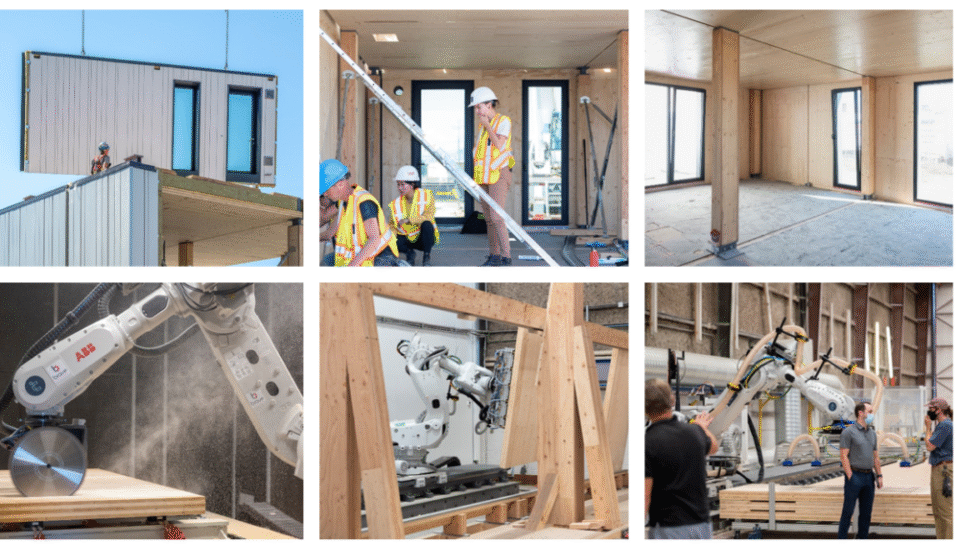
These challenges have shaped our pivot toward production-oriented housing solutions that leverage mass timber, prefabricated panelization, and repeatable design systems. By standardizing components off-site and creating systems that can be replicated across projects, we can achieve higher efficiency while maintaining quality and architectural integrity.
Innovators Leading the Way: Intelligent City
Intelligent City is one of the leaders in repeatable, scalable construction solutions. They specialize in:
- Mass timber construction for speed, strength, and sustainability
- Prefabricated panelized facades that reduce on-site labor and complexity
- Repeatable design systems that enable scalability across multiple projects
By combining these approaches, companies like Intelligent City demonstrate that construction can be both high quality and highly efficient, even at scale.
Why This Matters
The construction productivity decline has real consequences:
- Housing costs are higher than they should be (Richmond Fed, 2025)
- America faces a structural housing shortage of nearly 4.7 million homes (U.S. Chamber of Commerce, 2025)
- Infrastructure and public projects take longer and cost more
If productivity in construction had grown at even a modest 1% per year since 1970, housing would be far more attainable, and infrastructure projects more efficient.
By embracing mass timber, prefabricated panelization, and repeatable design systems, developers can finally close the gap between potential and actual productivity.
Conclusion
So how is it possible that construction labor productivity has fallen while the rest of the economy surged? It’s a perfect storm of regulation, complexity, fragmentation, and resistance to scale. For developers like us at Evolve, the lesson is clear: innovation in construction isn’t optional—it’s essential.
By integrating mass timber, prefabricated panelized systems, and repeatable design principles—and learning from leaders like Intelligent City—we can increase production efficiency, reduce costs, and help address the housing shortage that inspired this exploration. The housing-shortage blog is coming shortly, but understanding this productivity paradox is the first step toward meaningful solutions.

1 Comments
America’s Housing Crisis: Building 5 Million Homes Faster - Tyson Dirksen
December 5, 2025 - 3:27 am[…] For further context on productivity trends and how they amplify the shortage: 👉 How Construction Labor Productivity Dropped 30% […]