
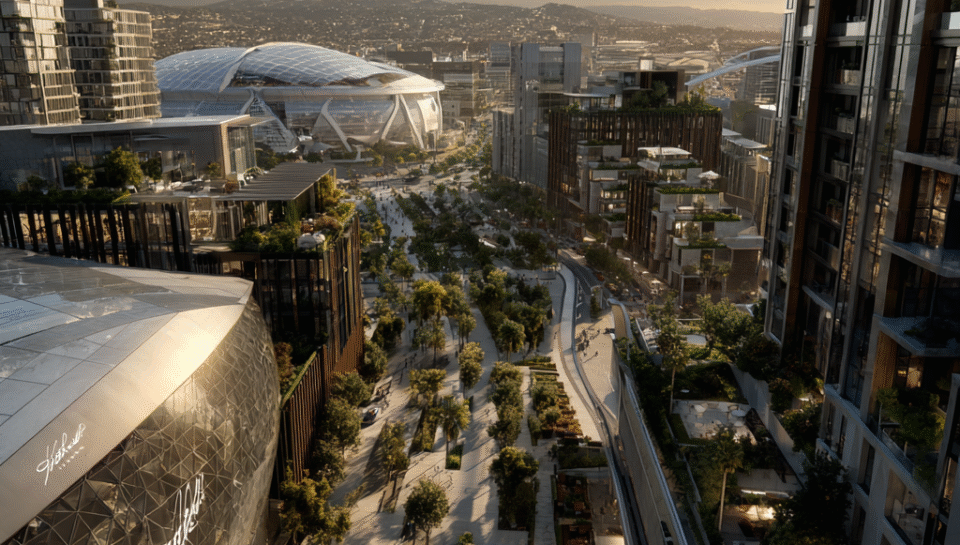
Los Angeles is treating the LA 2028 Olympics legacy city building opportunity as a long-term catalyst rather than a short-lived spectacle, with infrastructure and housing investments explicitly designed to avoid the “ghost venue” pattern of past Games.
Every Olympic cycle, cities promise transformation. New stadiums, shiny villages, and billions in investment are sold as catalysts for renewal. Then, too often, the crowds go home, the cameras turn elsewhere, and what is left behind is a scattershot mix of debt, underused venues, and missed opportunities. Think of Athens’ abandoned sports complexes or Rio’s empty Olympic Park, where ambitious plans for new districts and transport connectivity never fully materialized.
Los Angeles is trying to write a different story. Rather than treating the 2028 Olympics as justification for one-off mega-projects, the region is using the Games as a deadline to accelerate infrastructure and neighborhood investments that were already needed — and that should serve Angelenos for decades after the flame goes out. Ankura’s article, The Clock is Ticking: Managing Construction Schedule Risk Ahead of the 2028 Los Angeles Olympics, notes over $50 billion committed since 2017, including $30 billion for LAX and $20 billion for LA Metro’s 28 transit projects.
LA 2028 Olympics Legacy City Building at Scale
The headline number often cited is roughly $50 billion in capital flowing into greater LA, tied to the Olympics timeline. But it is important to understand what that figure actually represents. This is not one monolithic “Olympic stadium” line item. Instead, it is a collection of overlapping programs:
-
A $30 billion modernization of LAX, including a people mover, upgraded terminals, and better connectivity to transit and regional mobility.
-
Roughly $20 billion in LA Metro investments under the “28 by 28” banner, pushing forward long-planned rail extensions, station upgrades, and regional transit projects that make it easier to cross the basin without a car.
-
A $2.6 billion expansion of the Los Angeles Convention Center and $1.4 billion in temporary and semi-permanent venue infrastructure led by LA28.
None of these exist solely because of the Olympics, but the fixed 2028 deadline forces coordination, sequencing, and completion in a way that normal capital planning rarely does.
Why the LA 2028 Olympics Legacy City Building Model Matters
This is the real opportunity: use a non-negotiable date on the calendar to push through projects that will still matter in 2040 and 2050. A modernized international airport is not a four-week asset. A more robust regional rail network is not a “sports” investment. A better-connected convention center, upgraded Exposition Park, and improved public realm around key venues all change how residents and visitors experience the city long after the closing ceremony.
But the same hard deadline that creates opportunity also amplifies risk. Ankura notes that, as of late 2025, roughly half of the planned capital work remained incomplete, leaving a narrow window to deliver everything from transit extensions to venue upgrades. Schedule slippage on one component — a key rail segment, airport connector, or major venue package — can have cascading impacts on cost, public perception, and the long-term credibility of LA’s growth strategy.
Designing for Everyday Life, Not Just the Games
From a real estate and urban development lens, the most encouraging part of LA’s approach is how much of the spend is directed at assets with strong “day two” uses:
-
LAX remains the region’s global front door.
-
Metro lines and stations are an everyday commute and access infrastructure.
-
Exposition Park, SoFi Stadium, the Intuit Dome, and UCLA’s campus are embedded in existing neighborhoods and long-term institutional anchors.
When the flame is gone, UCLA is still a university, Long Beach is still a growing housing market, and the mixed-use districts around venues like SoFi Stadium and the Intuit Dome are designed to function as everyday destinations rather than special-occasion sites. That puts LA in stark contrast to models where entire parks, villages, or rail spurs were built for a single event and then struggled to justify their existence afterward.
Lessons from LA 2028 Olympics Legacy City Building
If you are a mayor, planner, or investor looking at future mega-events, LA’s playbook offers a few key lessons:
-
Start with a long-term city-building vision, then fit the Games into it, not the other way around.
-
Prioritize assets with strong post-event demand profiles, such as transit, airports, mixed-use districts, and permanent housing.
-
Use the fixed deadline to force coordination and delivery discipline, but invest heavily in schedule risk management so the rush to 2028 does not compromise quality or budgets.
The numbers are enormous — tens of billions at LAX, multi-billion-dollar rail extensions, a billion-dollar river corridor — but the real measure of success will be how many everyday Angelenos are still benefiting in 2040, 2050, and beyond.
If we are going to spend this much capital, this is the right north star: design for the Olympics, but build for the next 50 years. And if you want a compelling visual overview of what LA is planning, start with the video that sparked this piece: https://www.youtube.com/watch?v=kDsIrBG6_cs.

1 Comments
“LA 2028 Olympics Legacy City Building: How $50 Billion Is Reshaping Los Angeles - Evolve-us
February 2, 2026 - 6:20 am[…] https://tysondirksen.com/la-2028-olympics-legacy-city-building-how-50-billion-is-reshaping-los-angel… […]