Mass timber is usually framed as a sustainability decision.
That is too narrow.
For long-horizon capital, it is fundamentally a duration question.
The real issue is not whether timber lowers embodied carbon or creates warmer interiors — both of which it does. The issue is whether it compresses the capital exposure window in a way that is resilient, or whether it concentrates risk into a single manufacturing dependency.
In long-cycle development, time is the dominant variable. McKinsey (2017) documented that large construction projects routinely exceed schedule by 20–50%, and that schedule drift erodes returns more reliably than pure cost overruns. A four-month delay in a stabilized yield model does more damage to IRR than most sponsors are comfortable admitting.
When equity is fully deployed, vertical construction is underway, and revenue has not yet begun, each additional month compounds interest reserve burn, general conditions, insurance exposure, and macro repricing risk. That is the exposure window mass timber claims to compress.
The question is whether it actually does.
Where Timber Changes the Equation
Mass timber alters the risk profile in three concrete ways.
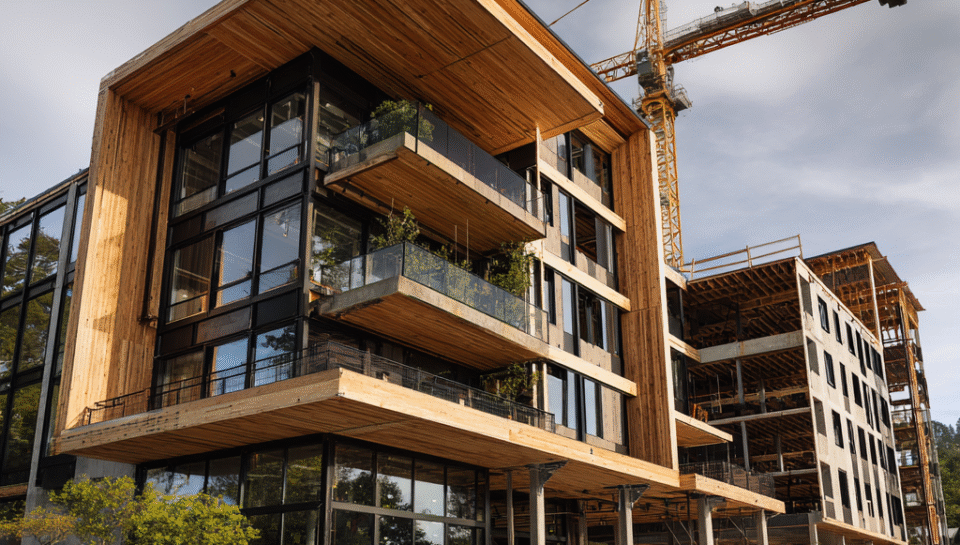
First, erection speed. CLT and glulam systems materially reduce on-site structural time. Multiple WoodWorks case analyses (2022) show 20–30% faster structural erection in mid-rise multifamily compared to cast-in-place concrete. That speed is not theoretical. Fewer wet trades, fewer cure cycles, and fewer trade stacking conflicts translate into faster dry-in.
Second, labor exposure. Off-site fabrication shifts a meaningful portion of execution risk from fragmented site labor markets to controlled manufacturing environments. In volatile labor conditions, that matters.
Third, weather compression. The faster a building is enclosed, the less it is exposed to moisture and weather-related schedule creep — a nontrivial factor in coastal and high-humidity climates.
These are real advantages. They are not marketing language.
But none of them matter if procurement fragility overwhelms them.
The Blind Spot: Procurement Concentration
Concrete is ubiquitous. Steel is globally liquid.
Mass timber manufacturing is not.
Forest Economic Advisors (2023) and WoodWorks industry data show that North American CLT capacity is expanding— but remains concentrated at a relatively small number of primary facilities. Lead times of 4–9 months are common, depending on complexity and backlog.
If a concrete pour is delayed, the project flexes.
If a CLT fabrication slot is missed, the project stops.
That is not incremental risk. That is binary risk.
The underwriting mistake I see repeatedly is modeling schedule compression at the jobsite level without shifting procurement lead times forward in the capital stack model. If the erection shortens by four months but the fabrication lock requires an early design freeze and early capital commitment, the duration may shift rather than shrink.
Timber reduces duration only if capital alignment is engineered around it.
A Short Sensitivity Illustration
Consider a $150 million mid-rise multifamily project with a 10% target levered IRR and 30-month construction timeline.
If stabilization is delayed by four months in a rising rate environment, with debt carry and lease-up push, IRR can compress by 80–120 basis points depending on leverage and exit assumptions.
Conversely, if structural speed and dry-in acceleration allow stabilization to occur four months earlier — and lease-up holds — IRR may improve by 60–100 basis points.
The spread between disciplined execution and procurement fragility is therefore not cosmetic. It is a full percentage point of return.
A Measured Environmental and Market Upside
It would be incomplete to ignore the sustainability dimension.
The IPCC Sixth Assessment Report (2021) identifies cement production as a significant contributor to global emissions. Lifecycle analyses across North American timber projects have shown embodied carbon reductions in the 30–50% range when replacing comparable concrete systems.
That has regulatory and tenant implications.
At the same time, visible timber offers something the market consistently values: authenticity. Heavy timber heritage buildings lease because people respond to material honesty. Operators like Hines have long observed the leasing strength of character-rich assets. Mass timber can replicate that spatial quality while delivering modern envelope performance and mechanical control.
There is also the biophilic factor. Research summarized by Terrapin Bright Green (2014) and subsequent studies suggests measurable wellbeing and cognitive benefits in environments with natural material exposure. In office or hospitality product, marginal productivity and satisfaction gains translate into economic relevance.
But sustainability does not override duration.
A six-month delay wipes out any carbon narrative in a rate-sensitive capital stack.
The power of timber is that, when sequenced properly, it can support both exposure compression and environmental positioning.
When Timber Becomes Institutional-Grade
Mass timber strengthens platforms when:
- Fabrication slots are secured before major equity deployment
- Engineering is fully frozen pre-manufacturing
- Secondary supplier compatibility is validated
- Lender and insurance approvals occur prior to panel production
- Infrastructure sequencing enables immediate vertical mobilization
In that configuration, timber is not a sustainability gesture.
It is a duration instrument with environmental tailwind.
It reduces peak exposure, supports leasing differentiation, and improves refinance optionality — provided governance discipline exists.
The Real Frame
Mass timber is neither conservative nor aggressive.
It is system-sensitive.
For allocators underwriting long-cycle development, the relevant question is not “Is it green?”
It is whether it compresses capital exposure in a resilient way.
If yes, it becomes a strategic asset class lever.
If not, it becomes a concentrated manufacturing bet disguised as innovation.
Time remains the dominant risk variable.
Materials either reduce that risk — or repackage it.