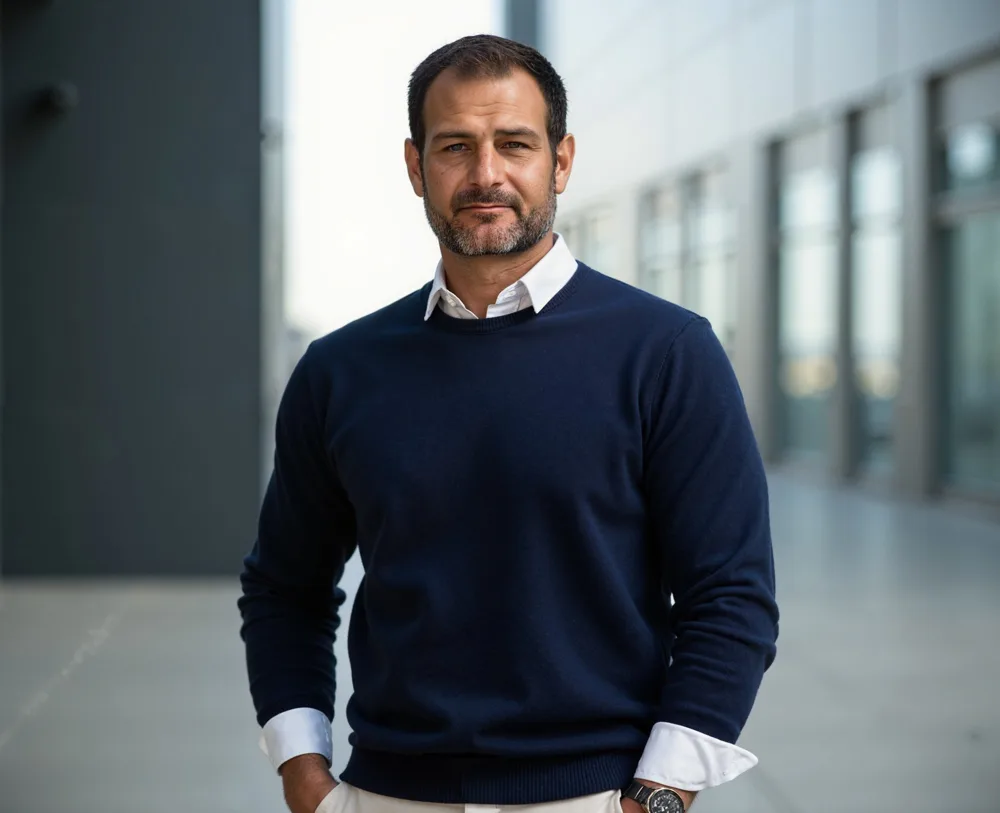
Tyson Dirksen has spent 30+ years in real estate development across California and the western United States. Luxury residential. Value-add multifamily. Complex urban infill. Pre-development advisory. The work has always centered on the same question: how do you take a project from conviction through regulatory exposure, construction risk, and operational reality — without losing the thread.
He served as broker of record for an institutionally backed value-add multifamily corporation with over $1 billion in assets under management, providing licensed oversight across acquisition, disposition, and portfolio repositioning activity spanning thousands of apartment units. That institutional-scale discipline carried forward into everything that followed. Not as a credential line. As an operating framework.
His direct construction experience includes high-performance residential builds delivering net zero and Passive House-certified outcomes. Continuous exterior insulation, fluid-applied barriers, structural thermal breaks, verified airtightness. The kind of work where tolerances are measured in pascals and failures show up in thermal images, not punch lists.
That building science foundation now drives the enclosure-first methodology at Evolve Development Group, his principal development platform.
He is a Certified Passive House Tradesperson and holds a Master of Science in Real Estate Development & Finance from MIT and a BA in Psychology from Brown University. He has previously held a California general contractor license, California real estate broker license, LEED AP accreditation, HERS Rater certification, and GreenPoint Rater certification.
His research and field observations are published across five clusters on this site: Capital Discipline, Development Systems, Development Governance, Housing Systems, and Construction Productivity. Development risk structuring and advisory work is conducted through Durata Advisory.
Site identification, feasibility analysis, market underwriting, and deal structuring across residential, mixed-use, and urban infill project types.
Regulatory strategy, zoning analysis, environmental review coordination, agency relationships, and community outreach across jurisdictions with complex approval requirements.
High-specification residential development across infill, coastal, and constrained urban environments — where enclosure quality, material selection, and construction sequencing directly affect product positioning and asset durability.
Repositioning and renovation of existing multifamily assets — including capital planning, sequencing occupied renovations, building systems upgrades, and enclosure retrofits — across California markets.
Program definition, vertical integration of residential and commercial uses, phasing strategy, and long-term asset planning across urban development environments.
General contractor procurement, construction sequencing, logistics planning, subcontractor management, and project governance across complex urban construction environments.
Building enclosure systems, moisture management, mechanical integration, indoor environmental quality, and high-performance building strategies as capital and risk decisions.
Structural risk analysis, development sequencing review, entitlement strategy, and capital structure evaluation for development teams before material exposure is committed.
Across more than three decades of development work, several structural patterns appeared consistently — regardless of project type, market, or cycle. These observations form the basis of the framework on this platform.
Tyson Dirksen operates across three active platforms, each occupying a distinct function within the broader development ecosystem.